
Dramatherapy · online, London & UK-wide
Dramatherapy: when words are hard to find
Some things are too big, too old or too tangled to talk about directly. Dramatherapy uses play, story, role-play and movement to help you explore them safely, at your own pace, with an HCPC-registered dramatherapist.

With Judy HarrisonHCPC-registered dramatherapist · HCPC AS14528
What is dramatherapy?
Dramatherapy, also called drama therapy, is a form of psychological therapy that uses drama and theatre methods: role-play, improvisation, storytelling, puppetry, movement and play. It brings together psychology and the creative arts, so you can explore feelings and experiences through doing, not only through talking.
That can help when words won’t come, when a memory feels too close to touch, or when talking about something in the usual way has gone round in circles. A story, a role or an object gives you a little distance, so you can look at what is hard from a safer place.
What people bring
- Trauma, or memories that feel too big to put into words
- Anxiety and worry
- Low self-esteem or a quiet inner critic
- Grief and loss
- Feeling stuck, or repeating the same patterns
- Identity, culture and belonging
- Life changes and turning points
- Wanting to understand yourself better
There is no need to know exactly what is wrong before you start. Many people come because something doesn’t feel right and they would like a creative way in.
What happens in a session
Every session is shaped around you. I bring a calm, steady structure and a choice of creative ways to work, and you decide how far to go:
Role-play
Step into a role, or into someone else’s shoes, to try out a conversation or see a situation from another side.
Improvisation
Small, playful exercises that let something new happen, with no script and nothing to get right.
Storytelling
Myths, fairy tales or a story you make up yourself give you a safe distance from what is hard to say directly.
Puppets and objects
A puppet, a figure or an everyday object can stand in for a feeling or a person, so you can look at it from the outside.
Movement and the body
Noticing posture, breath and movement, for when a feeling sits in the body before it has words.
Reflection
Every session leaves time to step out of the creative work and talk about what came up, at your pace.
You don’t need any acting experience, and there is no audience. Dramatherapy is about the process, not a performance.
How play and story help
Read the transcript
We were never allowed to play. It’s dangerous. Don’t go up too high, you’re gonna fall. Don’t go into the woods, you might not come out. Don’t go near the water, you might drown. We were never allowed to play. The adults, they had their way of playing. Plates being thrown, shouting, but not play shouting, hurtful shouting, naughty words, words that I’m certainly not allowed to say. We weren’t allowed to play. I’d walk into the room wanting to play with the others nearby, and they would walk out, because nobody wanted to play. I remember being sad one day, feeling so lonely, because I really wanted to play, and I knew, when I went to school, I always heard stories of my friends, and they would play every day. They’d get dirty. Sometimes they’d break an arm or a leg and come in on a crutch, or their hand in a cast. But me? I could only dream. But one day, in they came, into my imagination. I think there was an Inspector Gadget. There certainly was a Pink Panther. Bugs Bunny was there as well. We had a dinner party, and then she appeared. My imaginary friend. My imaginary friend would always turn up when the adults outside were playing in a way that wasn’t safe. Playing in a way that made me feel something I couldn’t quite articulate. She would appear and say, “Let’s go play.” And we would. We built a cardboard box hive, a cave where we would go inside, and we would have a dinner party, and we would sit down with our pinkies up, and we would sip our tea and say, “This is delightful.” Don’t you see? I learned to play in a very imaginary way. So when people say your childhood was awful and horrific, it probably was. But my friends, they came, they visited me, and they kept me company, and we played, and we played, and boy, oh boy, we played. And my imaginary friends came through every single day. Remember to play. Play heals, play distracts, play keeps you focused, so that the traumas going on in the real world doesn’t impact you. Go play.
Play is one of the first ways any of us learn to make sense of the world. As adults, many of us stop, or never had the chance. In dramatherapy, play is taken seriously: a story, a character or a game can hold feelings that are hard to say out loud, and let you try out something new without the stakes of real life.
In this short film, I talk about the imaginary friends who kept me company as a child.
“Remember to play. Play heals.”
Judy Harrison, from “Play Heals”
Stories work in a similar way. Stepping into a myth, a fairy tale or a story you make up yourself lets you meet a difficult theme at one remove, then bring back what feels useful to your own life.
Dramatherapy with me
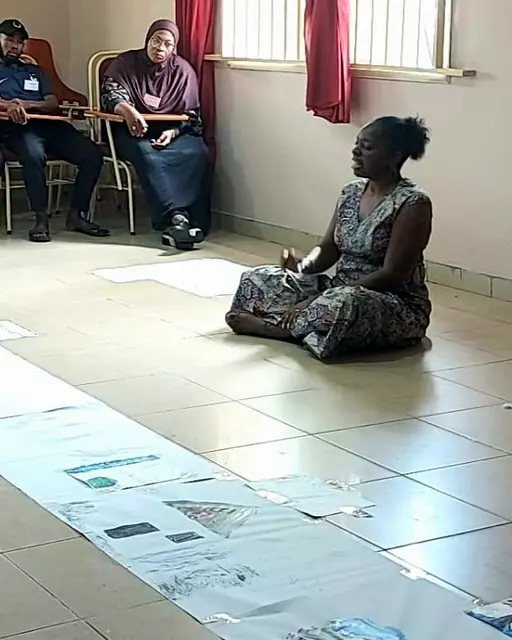
I am an HCPC-registered dramatherapist (HCPC AS14528) with an MA in Dramatherapy from Roehampton. I have worked with people since 2001, including children, young people and adults who have lived through a lot, and I am a co-founder of the Black Dramatherapists’ Collective.
My work is warm, creative and culturally aware. I also train other professionals, supervise therapists and bring dramatherapy into schools, children’s homes, theatres and organisations. Read more about Judy.
Dramatherapy online, wherever you are
Private sessions are online, by video, so you join from home: in London, anywhere in the UK, or abroad. The creative work comes with you: objects from around your home, paper and pens, your voice and your body all work on a screen. Online dramatherapy explains how it runs and what to have ready.
The first step is a short, confidential first consultation to see whether dramatherapy, and working with me, feels right for you. You can book it online at any time.
More on dramatherapy
Online dramatherapy
The same creative work by video, from home: London, anywhere in the UK, or abroad.
Read more about online dramatherapySchools & children’s homes
Dramatherapy for children and young people, contracted through schools, children’s homes and councils.
Read more about schools & children’s homesTheatre productions
Support for actors and companies working with difficult material, in the rehearsal room.
Read more about theatre productionsOrganisations & training
Creative CPD, workshops and group supervision for teams. Ask for a quote.
Read more about organisations & training
The first step
How to start
Book a time that suits you
Choose a slot online in a couple of minutes, or email me if you would rather ask a question first.
Talk it through
We talk about your reasons for seeking support, your hopes, and any questions about how therapy works.
Decide, with no pressure
If it feels right, we agree the approach that suits you. If not, that’s completely fine too.
Kind words
What professionals say about Judy
Judy’s wisdom and warmth radiates through her supervision style.
Isabelle, Drama Therapist I was held by Judy in a way that made being vulnerable feel safe, and it was in this that I was able to trust the process.
Kate, Specialist Trauma Counsellor Judy has a unique ability to create a safe space where people feel truly seen and heard.
Elizabeth, Google review
To protect client confidentiality, we only share words from fellow professionals, never from therapy clients.
Questions
Questions about dramatherapy
Can’t see your question? Read all the FAQs, email admin@therawake.co.uk or see other ways to get in touch.
What happens in a dramatherapy session?
Each session is shaped around you. You might use role-play, storytelling, puppets or small objects, movement or drawing, and there is always time to talk about what came up. I keep a calm, steady structure, so you know where you are, and you never have to do anything you don’t want to.
Do I need to be good at acting?
No. Dramatherapy is not about performing, and there is no audience. Many people who come have never acted and feel shy at first. I start gently and go at your pace.
What does a dramatherapist do?
A dramatherapist is a psychological therapist trained in drama and theatre, and must be HCPC-registered to use the title. I use creative methods to help you explore feelings, memories and patterns, and I listen and reflect with you along the way.
What do people come to dramatherapy for?
People come for many reasons: trauma, anxiety, low self-esteem, grief, feeling stuck, questions of identity and belonging, or simply wanting to understand themselves better. The first consultation is the place to talk about whether dramatherapy suits what you are going through.
Does dramatherapy work?
Dramatherapy is an established psychological therapy in the UK. Everyone is different, so I won’t promise a particular result. Instead, you agree what you would like to work on and review together how it is going.
How many sessions will I need?
It depends on you and what you bring. Some people come for a short piece of work, others for longer. We agree a plan together and review it regularly, and you can stop at any time.
How much does dramatherapy cost?
£25 for the first consultation, then £75 for each 50-minute session, all online.
Do you offer dramatherapy for children?
Yes. I see children and young people aged 8 to 18 privately, online, and I also work with them through schools, children’s homes, councils and other organisations. For anyone under 16, a parent or carer needs to give their consent. If you are a parent or carer, email me to talk about your child and what they need. For work in a school or setting, see schools and children’s homes.
Is dramatherapy confidential?
Yes. I explain how confidentiality works, and its few limits, before you begin.
Need help right now? Therawake is not an emergency service. If you or someone else is in immediate danger, call 999. For urgent mental health support, call NHS 111 (option 2), or talk to Samaritans any time, free:
Call Samaritans 116 123
Ready to take the first step?
You’ve already done something brave by looking. Book a confidential 30-minute first consultation (£25), or send me an email with any questions.